


Your shopping cart is currently empty.

Sign in and join Kleen Rite rewards to earn points and redeem rewards
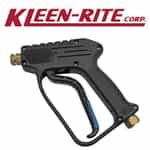
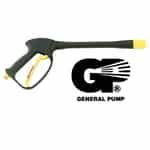
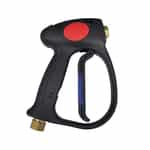
Pressure washer guns let you control the delivery of your high-pressure spray to the surfaces you are targeting! Squeezing the trigger allows liquid to flow through the gun, while releasing the trigger shuts off the flow. It's a delivery system that allows the user to move around with ease, while offering ergonomics that make the pressure washing tasks less tedious on the pressure washer. At the same time, the gun mounts the individual spray tips that help you to get the right angle and intensity - read more about that at the Kleen-Rite Blog!
Getting the right pressure washer gun is key to getting the best pressure washing result. These guns provide better efficiency, allowing you to tackle larger jobs, faster. Use them with portable or vehicle-mounted units, and with gas or electric pressure washers.
Pressure washer guns help to remove grease, dirt buildup, and grime from buildings and vehicles. Use them to clean cement, walls, siding, car tires, and more. Spray guns are also used as prep units for car washes, as well as washing down equipment and tunnels. These pressure washer guns are easy for car wash operators to use.
These tools control the high-pressure water flow generated by your pressure washer's pump, allowing operators to start, stop, and direct pressurized water or chemical solutions onto the surface being cleaned. The trigger opens an internal valve when squeezed, releasing pressurized water, and closes it when released to stop the flow.
A reliable commercial pressure washer gun solves common problems including leaks, premature failure from chemical exposure, and severe operator hand fatigue. They are designed to be held with one hand and accept a variety of accessories to help the operator accomplish multiple different tasks. Some accessories and lances will require two hands due to their length or the tool's design.
A standard consumer spray gun is not built to survive the daily demands of a professional wash environment. It's designed for a weekend warrior who uses it occasionally to clean a vehicle, driveway, or deck. When a professional operator pulls the trigger hundreds of times a day, weak internal components quickly fail. A commercial pressure washer gun is engineered with a significantly more durable design and higher-grade materials for longevity.
A pressure washer gun typically features metal fluid-handling components constructed using forged brass or stainless steel for durability and corrosion resistance. They are also more resistant to erosion caused by high-pressure fluid streams and harsher industrial-grade chemicals. Seals (O-rings) are made of Buna-N, EPDM, and other materials selected for their varying levels of chemical and temperature resistance. Most trigger guns are gripped with the fingers wrapped around the trigger while the thumb rests along the body for stability and control. Many newer spray gun models feature easy-pull triggers and locking mechanisms to help prevent unexpected activation.
The spray gun’s internal components are enclosed in a durable, impact-resistant plastic housing built to handle drops on hard concrete floors. Its ergonomic shape provides a secure, comfortable grip during extended use, while the outer shell helps shield the operator’s hand from hot metal when running heated water.
Each spray gun is equipped with inlet and outlet connectors. The inlet allows water to enter the gun; it's located at the base, where it attaches to the hose coming from the pump outlet. The outlet allows water to exit the gun; it's located at the front, where a wand, lance, or nozzle connects. Connection types can vary between threaded, quick-connect, and M22 fittings across consumer, prosumer, and select commercial models.
Upgrading to a professional pressure washer gun improves the entire cleaning process. You get better flow control, fewer leaks, and a longer lifespan. Whether you run a commercial pressure washing business, an industrial cleaning operation, a detailing shop, or a mobile detailing business, investing in a professional-grade trigger gun keeps your operation running smoothly.
Matching the right pressure washer gun to your system starts with understanding the key compatibility specifications and safety considerations.
Given the wide variety of pressure washers, spray guns, hoses, and accessories on the market, it's not possible to recommend a single gun that's compatible with every setup. Use the checklist below to confirm the right fit for your equipment.
When selecting a new pressure washer spray gun, you MUST match the gun to your system’s exact specifications. The two most critical specifications are the maximum operating pressure (PSI - Pounds Per Square Inch) and flow rate (GPM - Gallons Per Minute).
Every professional pressure washer gun is rated for a maximum pressure limit. Using a spray gun rated for 3,000 PSI on a 4,000 PSI pressure washer is dangerous and will cause immediate equipment failure. The components will not be able to contain the excess force and can burst, causing injury. This matters not only for your safety, but also for the safety of your employees, bystanders, and the property where you are working. Always choose a gun that meets or exceeds your pump’s maximum pressure output. Many popular professional options are rated at 3,200, 4,000, or 5,000 PSI, giving you a safe buffer for heavy-duty applications. Some models can handle up to 7,000-10,000 PSI for specialty applications.
Pressure and flow rate work together to clean effectively, and your spray gun must be able to handle your system's total flow rate. A high-flow pump requires a high-flow gun. Restricting a high-volume pump with a low-capacity spray gun forces the unloader valve to work harder, cycling more frequently to manage the excess flow. Over time, this added strain can accelerate wear on the unloader valve, pump seals, and other components. Most commercial pressure washer systems are rated between 4 and 8 GPM, while systems for heavy equipment and industrial cleaning applications are rated to handle 8 to 10 GPM without restricting flow. Check your pump's flow rate and ensure your gun can handle the full volume without restriction.
Soft wash systems operate at much lower pressure than standard pressure washing equipment to protect delicate surfaces, as high pressure can damage them. These systems generate higher flow rates because soft washing requires a high volume of water to safely apply chemicals and rinse away debris, rather than physical pressure. Soft wash systems typically operate between 100 and 500 PSI, with flow rates ranging from 4 to 20 GPM or higher. The gun's GPM rating is especially important here, but the same matching principle applies with pressure ratings. Always choose a gun rated to handle your soft wash system's specific pressure and flow output.
A spray gun is only useful if it connects properly to your existing equipment. Understanding standard industry fittings will help you choose the right replacement parts.
Most commercial spray guns feature a 3/8-inch female NPT (National Pipe Thread) connection on the inlet. To attach your high-pressure hose, you typically install a 3/8-inch quick-connect (QC) plug or coupler. Many consumer, prosumer, and select commercial models have M22 threaded connections. If your current setup uses M22 fittings, you can easily find adapters to convert them to standard 3/8-inch quick connects.
Common inlet connection types include:
Outlet connections on pressure washer spray guns are typically 1/4-inch female NPT thread. Operators often thread a stainless steel lance or wand directly into this outlet. Alternatively, you can install a 1/4-inch quick-connect coupler at the outlet. This allows you to quickly swap between different wand lengths or attach a foam cannon directly to the gun. Detailers and pressure washing professionals who rely on multiple tools and attachments for each job prefer a setup that makes tool changes fast and easy.
Common outlet connection types include:
Pressure washer fittings are either "male" or "female." This refers to how two connectors join together.
A male threaded fitting has external threads that screw into a female fitting's internal threads.
The same male/female concept applies to quick-connects, using a plug (male) that inserts into a coupler or socket (female).
M22 connections also follow the same male/female threading concept, with a male M22 fitting threading into a female M22 fitting.
Because both sizes use the same M22 thread pitch, a 14mm and 15mm fitting can sometimes screw together without fully sealing, leading to leaks or connection failure under pressure.
Most spray gun inlets and outlets use female connections, so you'll typically need a male-ended hose, wand, or attachment to connect to them. When ordering replacement parts or adapters, always check whether you need a male or female connector to match your existing equipment.
Weep guns are designed for fixed installations, such as self-serve car wash bays, where a small continuous trickle of water prevents the plumbing lines from freezing in cold weather. If you're operating a typical pressure washer, a non-weep gun, which fully stops water flow when the trigger is released, is typically the correct choice.
The lifespan of a spray gun comes down to its internal engineering. The valve assembly handles intense mechanical stress every time the trigger is pulled and released.
Most professional spray guns use either brass or stainless steel for the main valve housing. Brass is corrosion-resistant and works well for standard cleaning applications. However, stainless steel offers greater durability and superior corrosion resistance. Plus, it handles extreme pressure spikes and highly acidic or alkaline chemicals much better than brass.
Inside the gun, a small ball presses against a seat to stop the flow. In high-quality models, this ball is often made of hardened ceramic or stainless steel. These materials resist the erosion of high-pressure water streams. When a gun starts leaking from the wand, it usually means the ball or seat is worn out. Heavy-duty internal parts delay this wear, reducing replacement costs.
Operator fatigue is a common challenge in the pressure washing industry. Gripping a high-pressure trigger for hours at a time can cause significant hand, wrist, and forearm strain. Modern commercial spray guns use swivels, advanced triggers, and ergonomic grip designs to help solve this issue.
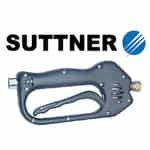
Standard trigger mechanisms require continuous force to keep the valve open against water pressure. While the initial trigger pull isn't heavy, keeping the trigger depressed during long jobs or constant activation can lead to fatigue. Suttner's "Easy-pull" technology drastically reduces the initial force needed to pull the trigger. Their "Relax-action" technology goes a step further by also significantly reducing the force required to hold the trigger down compared to standard spray guns. This simple upgrade keeps your operators comfortable, focused, and efficient throughout a long shift. Manufacturers often use different names for similar technology, so look for terminology like "easy-pull," "relax-action," "low-effort," or "reduced-force" when comparing spray gun options.
Beyond the trigger mechanism itself, the shape and material of the gun's grip play a major role in reducing fatigue. Pressure washer guns with contoured grips that naturally fit a user's hand help distribute pressure more evenly across the hand and require less force to grip. A textured or stippled grip helps to reduce slipping, especially when hands are wet or gloved.
Hoses can often be heavy, rigid, and prone to tangling and kinking. Wrestling with a twisted or kinked hose places extreme stress on the operator's wrists. A built-in swivel on the gun's inlet allows the hose to rotate freely while under pressure, preventing kinks and extending the life of your hose. This added mobility also makes it easier to move around job sites and equipment. If your current gun does not have a swivel, you can often add an external swivel fitting, but an integrated design is lighter and more streamlined.
Pressure Washer and Accessory Compatibility
Your spray gun's outlet connection determines which attachments and cleaning tools you can use with it, so it's worth thinking through your setup before you buy.
Remember: The same pressure-matching principle applies to every accessory in your setup (wands, lances, nozzles, and foam cannons); all need to be rated for your system's operating pressure, not just the gun itself. No component in your setup should be rated below your pump's maximum pressure output.
How you approach this depends on whether you're starting from scratch or already have equipment on hand:
Buying a New Gun and Building Your Attachment Setup
If you're starting fresh, you have flexibility to choose your connection type based on how you plan to use the gun. Quick-connect outlets provide the most versatility. They are most useful for users who need to swap between multiple wands, nozzles, and accessories such as foam cannons, gutter attachments, and other tools (though surface cleaners, which are often self-contained units, typically need the quick-connect fitting at the end of a wand, not at the gun, so the operator can stand upright instead of bending over to use the tool).
Replacing a Gun When You Already Own Wands, Lances, or Accessories
If you're replacing a damaged or worn-out gun but keeping your existing wands and attachments, match the new gun's outlet connection to what you already have on hand. Otherwise, you'll need to order adapters or new attachments that fit with your spray gun. Purchasing a spray gun with the correct connections is likely a far cheaper route here.
Professionals rely on brands known for producing pressure washer guns with exceptional longevity. These manufacturers and recommended models have proven their reliability in many applications and environments.
Suttner is renowned worldwide for German-engineered durability. They offer some of the most reliable models on the market.
MTM Hydro produces premium Italian-made spray guns highly favored by detailers.
Mosmatic represents the top tier of premium pressure washing equipment. Their spray guns are built with high-grade stainless steel and feature some of the smoothest, most durable swivels in the industry. They are ideal for high-end detailing operations, pressure washers who need durable tools, and heavy equipment washing that requires higher flow rates.
Different jobs require different spray gun configurations. Customizing your setup improves speed and cleaning results.
Detailers need compact, maneuverable tools. The most popular setup is a "snub nose" spray gun. This involves attaching a quick-connect coupler directly to the gun's outlet without a long wand. This short profile is perfect for working close to the vehicle, washing inside wheel wells, and seamlessly attaching a foam cannon. An easy-pull trigger and a live swivel are considered essential for this setup. Some may use lances with a quick-connect fitting for taller vehicles.
Self-serve bays need maximum durability. Customers are rough on equipment. Guns are frequently dropped, dragged, and frozen. Wash owners typically use simple, heavy-duty guns paired with a long, rigid or flexible lance. Fixed weep systems are also common here during the winter months. A "weep" gun allows a small amount of water to flow continuously even when the trigger is released, preventing the water lines from freezing when the temperature drops below the freezing point.
Washing tractors, trailers, and construction equipment requires high flow and extreme pressure. Operators in this field use long lances (often 36 to 48 inches) to reach high areas safely. They rely on high-capacity guns that can handle higher flow rates without restricting the flow.
Hot water pressure washers need a spray gun rated for both heat and pressure. If the gun is not built for high-temperature fluid, seals can fail, and other components can wear out faster. That leads to leaks, downtime, and unsafe operation. Always check the gun’s maximum temperature rating before you install it on a hot water unit.
Repair kits are best for addressing common wear issues like leaking valves, worn balls and seats, or damaged O-rings, especially on spray guns that are otherwise in good condition. However, if the gun's metal housing is cracked, the trigger mechanism itself is damaged, or the gun has been used well beyond its expected service life, replacement is typically the more cost-effective option. As a general rule, if repair costs approach the price of a new gun, replacing it makes more sense.
Rebuilding a spray gun is a simple process you can typically complete quite fast. Repair kits usually include replacement O-rings, valve springs, balls, and seats. These are the components that tend to wear out over time.
Repair steps vary by brand and model, so always consult your specific gun's instructions or manufacturer resources before starting. In general, the process follows these steps:
Safety Tips
Installing a new spray gun is a relatively quick process, but steps can vary slightly depending on your gun's inlet and outlet connection types. Generally, the process follows these steps:
Safety Tips
Even the highest quality spray gun will eventually require maintenance. Knowing how to troubleshoot and repair your equipment prevents unnecessary replacements.
If water constantly drips or sprays from the nozzle when the trigger is released, the internal valve is failing to close. This is the most common issue. It usually means debris is holding the valve open, or the internal ball and seat are worn out.
Leaks at the base of the handle are usually caused by worn O-rings in the swivel or a loose threaded connection. Wrapping the threads with high-quality Teflon tape and tightening the fittings often solves the issue. If the swivel itself is leaking, the internal seals are damaged. You will need to replace the seals or the whole swivel if a repair kit is not available.
You do not always need to buy a brand-new gun. Most professional models have a specific repair kit available. These kits include replacement O-rings, valve springs, balls, and seats. Rebuilding a spray gun is a simple process that is relatively fast. Keeping a few repair kits in your parts room is a cost-effective way to manage equipment wear. You will need to replace the gun when the metal housing cracks.
Freezing temperatures can destroy a spray gun and pressure washing equipment. Water left inside the valve expands when it freezes, cracking the brass or stainless steel housing. Always drain your lines and add pump winterizing antifreeze through the system when storing your pressure washer in cold conditions.
Yes! For regular commercial or professional use, upgrading from a cheap consumer gun to a professional pressure washer gun is one of the best investments you can make. Professional models last significantly longer, reduce operator fatigue, and handle higher pressure safely. The time and money saved from not having to constantly replace broken consumer guns quickly covers the higher price of a pro-grade unit.
For occasional home use, cleaning a driveway or deck a few times a year, a consumer-grade gun is often sufficient, since the investment in a commercial-grade model may not pay off at that level of use. However, if you're an automotive enthusiast who cleans your vehicle (or vehicles) weekly, it might be worth the upgrade, as lighter triggers and hold features will make the spray gun much more comfortable to use.
If you already own a commercial-grade gun and it's showing wear, repairing it is often more economical than replacing it outright. See the guidance above in the section labeled When to Repair vs. Replace for more details.
The device you hold to control the water is commonly called a trigger gun, spray gun, or simply a gun. When the gun is attached to the long metal pipe and the nozzle, the entire assembly is often referred to as a wand or lance assembly.
There is no single "best" option, as it depends on your specific needs. Refer back to our quick checklist to choose a spray gun that is compatible with your equipment. Generally, the decision hierarchy looks like this:
No. You cannot use just any spray gun. You must ensure the gun is rated to handle the maximum PSI and GPM of your specific pressure washer pump. Additionally, you must verify that the inlet and outlet fittings match your hose and wand connections.
Professionals use heavy-duty trigger guns made with forged brass or stainless steel internals. They prefer models with easy-pull triggers to reduce fatigue, and they almost always incorporate quick-connect fittings for rapid switching between wands, nozzles, and foam cannons. Just as important, professionals match their entire system — gun, hose, lance, nozzle, and fittings — rather than focusing on the gun alone, since every component needs to handle the same pressure and flow rating to work safely and effectively.
No. A pressure washer spray gun is designed exclusively for water and approved cleaning chemicals. It operates at much higher pressures than paint equipment and uses completely different internal mechanics. Using paint in a pressure washer can clog internal components, damage seals and valves, and contaminate the system, leading to equipment failure and improper operation. If you need to apply paint, use a dedicated paint sprayer.
Foam cannons are best used with quick-connect systems. Install a 1/4-inch female quick-connect coupler onto the outlet of your trigger gun. The foam cannon will have a 1/4-inch male quick-connect plug. This allows you to snap the foam cannon directly onto the gun, apply your soap, and then quickly swap back to your rinse nozzle. Some setups use a lance or wand with the quick-connect fitting instead, allowing the foam cannon to attach at the end rather than directly on the gun.
Get your order fast! Our strategically located warehouses help us ensure orders with delivery addresses in the lower 48 states receive their deliveries within 3 days. Plus, we have a generous rewards program that helps you save on shipping and rewards you with Kleen-Kash that can be redeemed to lower the cost of your orders.
Note: These delivery times may be impacted by order submission time cutoff, inclement weather, and other extenuating circumstances.
Due to the wide range of manufacturers we support, warranty coverage and return policies can vary by manufacturer and product. For official details, please review our warranty information and returns policy.
Explore the Kleen-Rite Loyalty Rewards program and find out all the ways you can earn points and get rewards to ship your supplies for free. We also have special free shipping options during the year. For example, we include a code for free shipping in our Kleen-Scene magazine published twice a year (February and August).

Your shopping cart is currently empty.
Sign in and join Kleen Rite rewards to earn points and redeem rewards

